Blogger Templates

Monday, 24 October 2011

GEAR CHANGE DSG


The principle of overlapping gear changes in the DSG is as follows: when one gear is engaged, another gear is always preselected. If a gear change is approaching, one clutch opens within three to four hundredths of a second while the other closes. The mechatronics module ensures that this takes place fast and accurately in a way that would not be possible manually. In this way, the change of gear is imperceptible to the driver and is achieved without any reduction in traction


The decision as to which gear should be engaged next is made by the control unit based on the position/operation of the accelerator, engine speed and vehicle speed. If the accelerator pedal is pressed and the vehicle accelerates, the next-highest gear will be preselected before the shift point is reached. If the accelerator is not pressed, however, i.e. if the vehicle is in overrun, the next-lowest gear will be pres elected.


The advantages in detail:
  • The Volkswagen DSG allows smooth, entirely jerk-free gear-changes combined with the comfort of an automatic gearbox.
  • The very effective dual clutch even cuts the fuel consumption of some models featuring DSG to below that of manual models (depending on driving style).
  • The manual gear selection option can deliver sporty driving pleasure thanks to its instantaneous gear changes. Depending on the model of car, the gears can also be changed using the gear-shift paddles on the steering wheel.
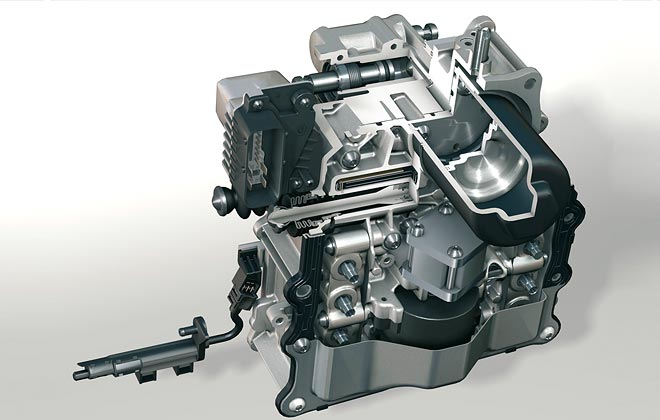
mechatronic - electric mechanic in one unit dsg


The clutches and gearbox units in the DSG are operated hydraulically. This function is performed by the gearbox mechatronics module, housed in the DSG. The term “mechatronics” is derived from combining the words “mechanics” and “electronics”. And this is exactly how the mechatronics module is structured with the electronic transmission control unit, various sensors and the hydraulic control unit all forming one compact entity.


The control unit uses information such as engine speed, driving speed, accelerator position and driving mode to select the optimum gear and to determine the ideal shift point. The hydraulic control unit then implements the shift commands in a complex sequence of individual, precisely coordinated actions.


The mechatronics module can perform complex shift operations in a fraction of a second. It consists of a control unit and a control valve assembly together with individual sensors and actuators. The gearbox’s control unit is in constant communication with the engine control unit. This “dialogue” determines the ideal point at which to make a gear change, which means the engine is always only consuming as much fuel as it needs to at that point.

how it work dsg


Volkswagen’s dual-clutch gearbox combines the ease of a conventional automatic transmission with the power of a manual transmission. It consists of two independent gearbox units. Through the dual clutch, both gearboxes are connected alternately and positively to the engine via two drive shafts depending on the current gear. The dual clutch’s hydraulic actuators allow gear changes to be executed without any reduction in traction.


The gearbox is controlled through a so-called mechatronics module, which contains the electronic transmission control unit, various sensors and a hydraulic operation unit in one compact package. The dual-clutch DSG has two driving modes: Normal and Sports. In the Sports mode, the DSG extends the gears further and, if required, can change down sooner too. The gear changes can also be executed manually however. You can make the whole process even sportier by using the rocker switches on the multi-function steering wheel. The clutch is always applied completely automatically

Depending on what your driving requirements are, a selection of DSG versions with different features can be used to ensure the perfect drive.


For engines with a torque of up to 250 Nm


The DSG for torques of up to 250 Nm is ideal for use in cars with smaller, more economical engines. The crucial component of the DSG is its “dry” running clutch. It dispenses with the oil bath needed in conventional designs, making it completely unique. Together with many other advantages, the dry, hydraulically-controlled dual clutch means that the amount of gear oil needed is much less as the oil is only needed for greasing the gears and bearings and not for cooling the clutch. This produces a significantly higher level of efficiency. This DSG also has a 7th gear with a large gear ratio, which also plays a major role in the system’s economical fuel consumption.


For engines with a torque of over 250 Nm

The DSG for torques of over 250 Nm is ideally suited for use in cars with more powerful engines. Its unique feature is two “wet” multi-plate clutches in an oil bath. A shared oil circulation system serves to grease the gears, cool the dual clutch and maintain the hydraulic shift position. There is a choice of a 6-speed gearbox for medium-sized cars and medium loads and a 7-speed gearbox for large cars with heavy loads.

Tuesday, 11 October 2011

advantage and disadvantage DSG


advantage DSG
  • The DSG from Volkswagen allows quick, smooth gear changes with the ease of an automatic transmission.
  • The fuel consumption of cars with a DSG is sometimes lower than that of models with a manual transmission (depending on driving style).
  • The manual gear selection option can also deliver sporty driving pleasure if desired and can be operated using the rocker switches on the steering wheel.


disadvantage DSG
  • Achieving maximum acceleration or hill climbing, while avoiding engine speeds higher than a certain limit (e.g. 3000 or 4000 RPM), is difficult since it requires avoiding triggering the kick-down-switch. Avoiding triggering the kick-down-switch requires a good feel of the throttle pedal, but use of full throttle can still be achieved with a little sensitivity as the kick-down button is only activated beyond the normal full opening of the accelerator pedal. 
  • Marginally worse overall mechanical efficiency compared to a conventional manual transmission, especially on wet-clutch variants (due to electronics and hydraulic systems).
  • Expensive specialist transmission fluids/lubricants with dedicated additives are required, which need regular changes.
  • Relatively expensive to manufacture and therefore increases new vehicle purchase price.
  • Relatively lengthy shift time when shifting to a gear ratio which the transmission ECU did not anticipate (around 1100 ms, depending on the situation).
  • Torque handling capability constraints perceive a limit on after-market engine tuning modifications (though many tuners and users have now greatly exceeded the official torque limits). Later variants have been fitted to more powerful cars, such as the 300bhp/350Nm VW R36.
  • Heavier than a comparable Getrag conventional manual transmission (75 kg (170 lb) vs. 47.5 kg (105 lb)).
  • Mechatronic units in earlier models are prone to problems and requires replacement units


Friday, 7 October 2011

VW DSG (direct shift gear)

Photobucket


Volkswagen’s Direct Shift Gearbox (DSG) is the world’s first dual-clutch automated manual gearbox in a production car. This provides the driver the ease-of-drive of a car equipped with an automatic transmission, but the efficiency and flexibility of a manual transmission.

It’s like a far more advanced big brother of automated manual transmissions like the one found in the Proton Savvy AMT. Something like BMW’s, SMG, but Volkswagen’s DSG was the first to have dual clutches. Volkswagen’s DSG transmission also has a triptronic function, allowing gears to be manually selected as well as an automatic mode.

A conventional manual gearbox has a human foot-operated single clutch. A DSG transmission has two clutches, one for the even gears and one for the odd gears plus the reverse gear. One clutch is in gear, while the other pre-selects the next gear. This allows really fast shifts, no more than three to four hundredths of a second. For example, if the car is in third gear, the other clutch already has fourth gear selected but is not active. As soon as the RPM reaches the ideal shift point for the car’s torque curve, the gearbox shifts into fourth gear almost instantly.